Volume of a Sphere: How Archimedes Found It — and Wanted It on His Tomb
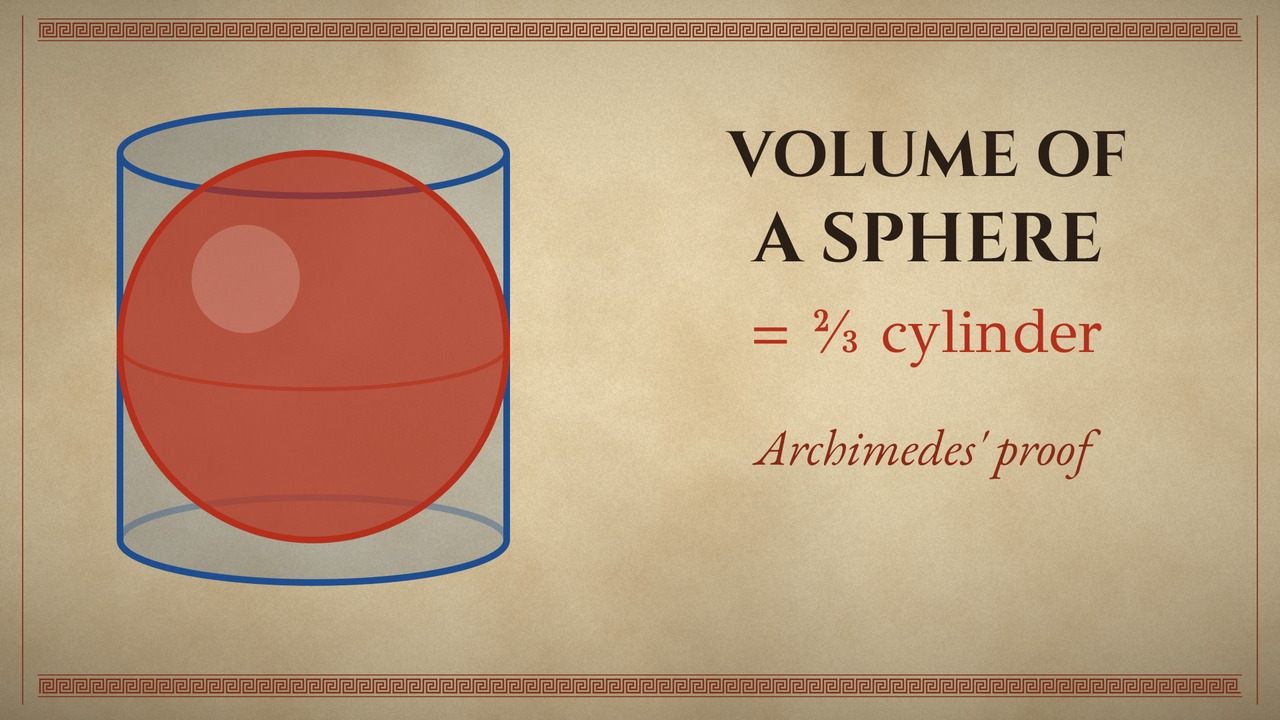
Archimedes proved in On the Sphere and Cylinder that a sphere is two thirds of the cylinder that fits exactly around it. That cylinder holds πr² · 2r = 2πr³, so the sphere holds ⅔ · 2πr³ = 4/3 πr³. With the cone of the same base and height, the volumes are in the ratio 1 : 2 : 3.
One, two, three
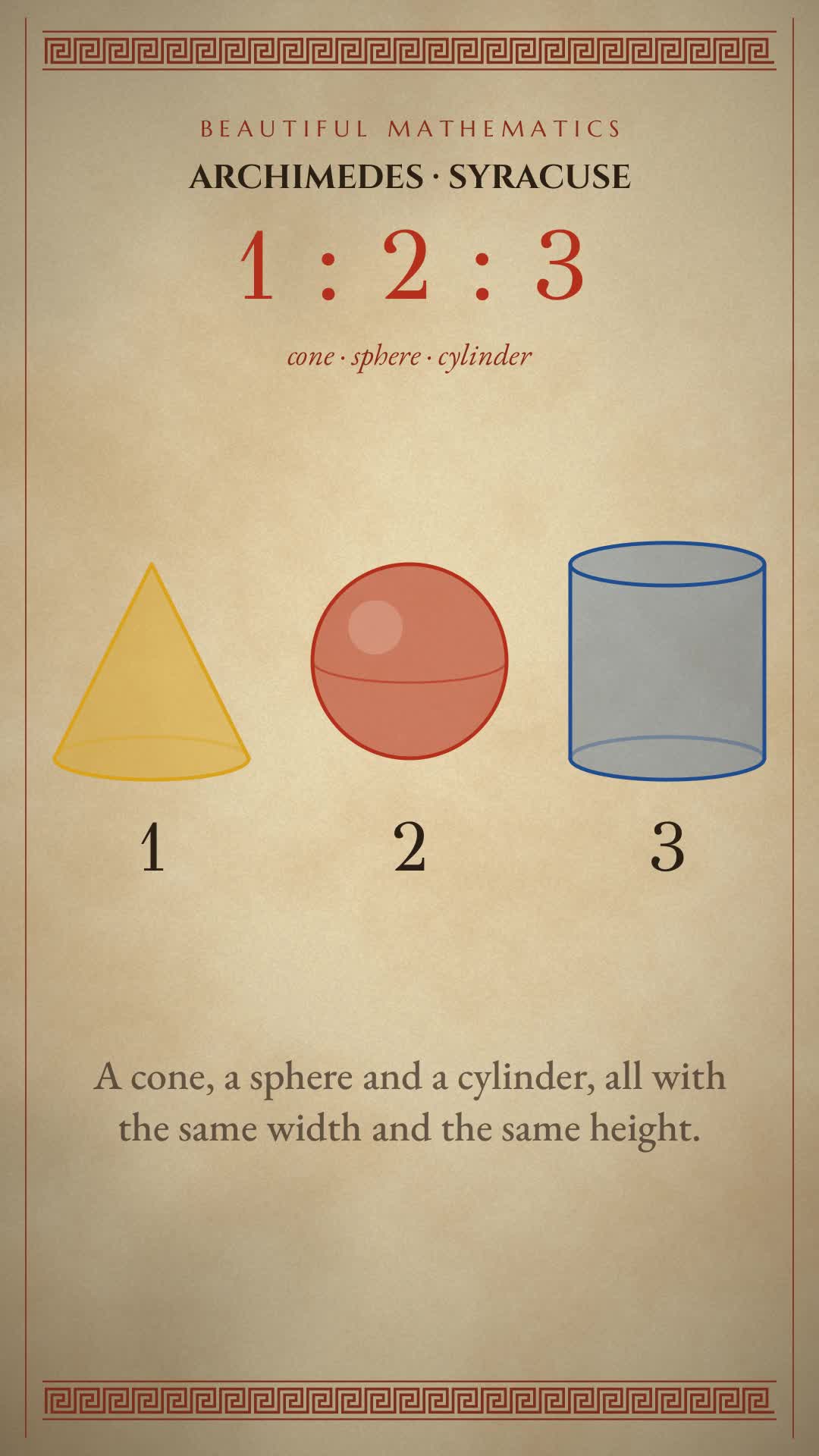
Take a cone, a sphere and a cylinder, all with the same width and the same height. Fill them with water. The volumes come out in the ratio 1 : 2 : 3.
This is the reason the volume of a sphere is 4⁄3 πr³ — found nearly two thousand years before calculus existed. Archimedes was so proud of it that he wanted it on his grave.
The video loads from YouTube (youtube-nocookie.com) only after you click. See our privacy policy.
Archimedes of Syracuse
Archimedes lived in Syracuse, on Sicily, around 287 to 212 BC. These dates come from later writers. He was famous as an engineer, but his own writings are mathematics. Several of them are letters to mathematicians in Alexandria. One, sent to a man called Dositheus, is called On the Sphere and Cylinder.
The claim
Near the end of its first book, Archimedes proves two things:
Then he draws the consequence: a cylinder that fits exactly around the sphere is one and a half times the sphere. And the same holds for the surfaces — the cylinder's surface, top and bottom included, is one and a half times the surface of the sphere.
Checking it with today's formulas
Archimedes wrote none of these formulas. He compared one shape with another. In today's notation:
cylinder: πr² · 2r = 2πr³ sphere: 4⁄3 πr³ = ⅔ · 2πr³
The surface works the same way: four great circles make 4πr², and the cylinder's surface, top and bottom included, is 2πr · 2r + 2πr² = 6πr² — again one and a half times the sphere's.
A cone with the same base and height is one third of the cylinder (see the volume of a pyramid). So:
cone : sphere : cylinder = ⅔ πr³ : 4⁄3 πr³ : 2πr³ = 1 : 2 : 3
How he found it: a lever
In another letter, called The Method and written to Eratosthenes, Archimedes explains how he found the result.
For this argument, the cone and cylinder are twice as wide as the sphere, but just as tall. He imagined their circular slices as weights on a lever: the slices of the sphere and cone were moved to one fixed point on one side, while the cylinder slices stayed at their different distances on the other. Everything balances — and the balance gives the volume of the sphere.
A lost book under a prayer book
The Method was lost for centuries. A copy made in the 10th century was scraped off and overwritten as a prayer book; the date in that book is 1229.
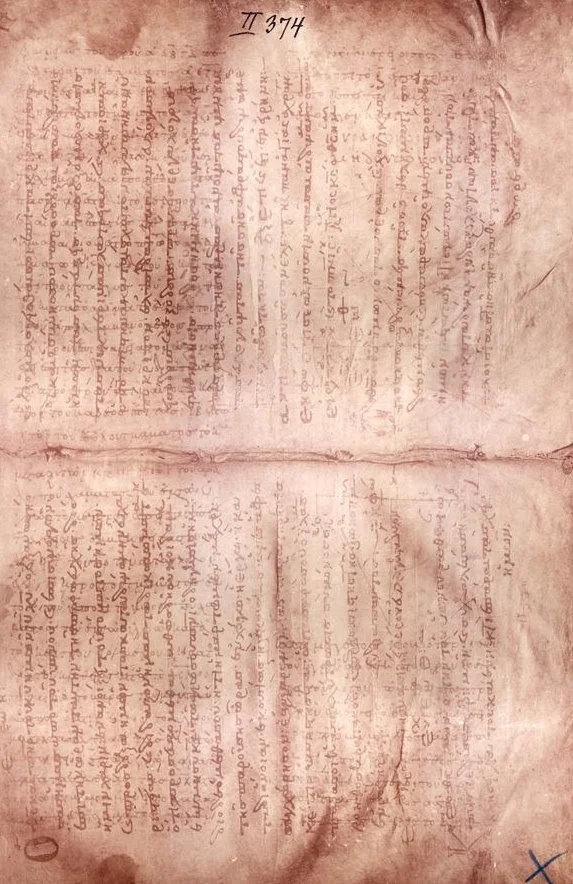
In 1906, the scholar Johan Ludvig Heiberg recognised the faint text underneath. After the book was sold at auction in 1998, it was imaged with modern methods, and much more of it could be read.
The proof he trusted
The proof in On the Sphere and Cylinder is different. Archimedes fits figures inside the sphere and around it, and shows that the sphere cannot be larger, and cannot be smaller, than his claim. Only one value is left — the same pattern as in his proof for the area of a circle.
He did not start from nothing. In The Method he says that Democritus stated that a cone is one third of its cylinder, and that Eudoxus proved it.
The tomb
According to Plutarch, Archimedes asked his friends to place on his tomb a cylinder enclosing a sphere, with the ratio.
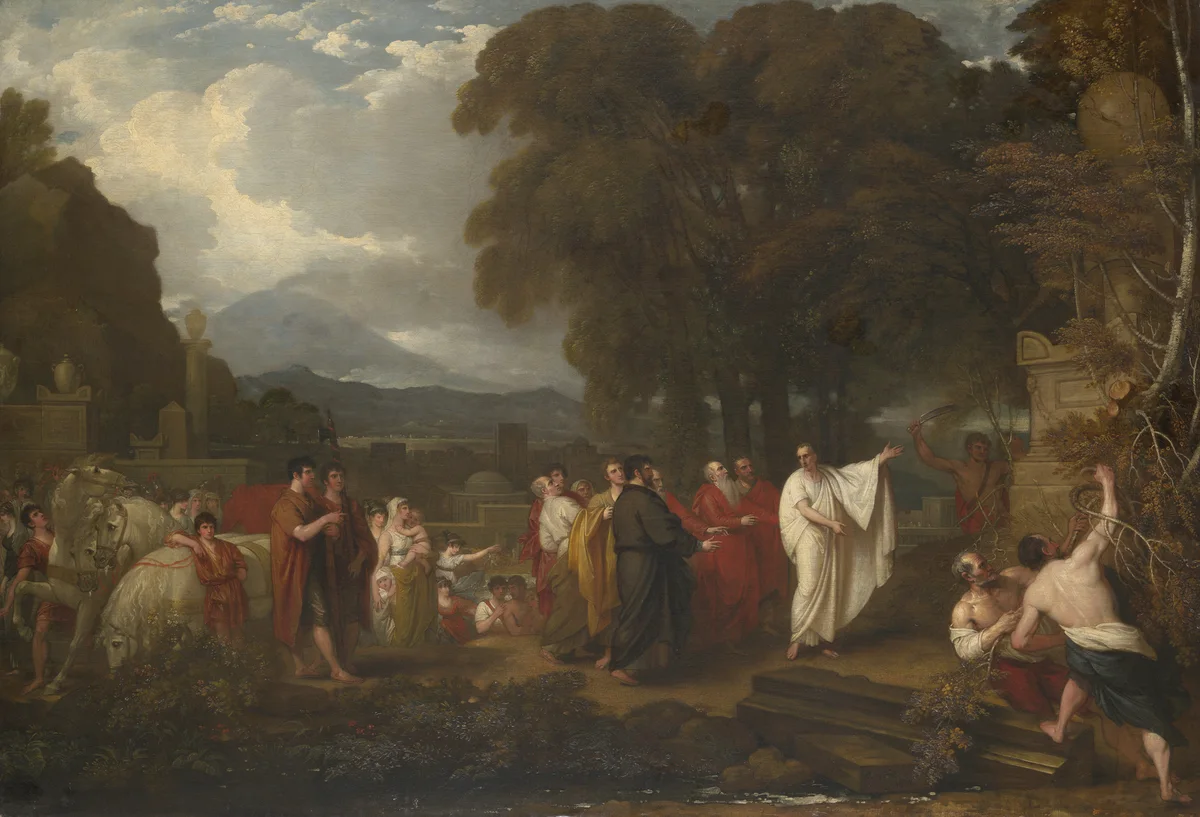
In 75 BC, Cicero says he found the neglected tomb near Syracuse: a small column, overgrown with brambles, bearing a sphere and a cylinder. The local people had forgotten where it was.
Try it yourself
If the cylinder holds 30 litres of water, how much does the sphere hold? And how much the cone?
The video loads from YouTube (youtube-nocookie.com) only after you click. See our privacy policy.
Sources
- Archimedes, On the Sphere and Cylinder I, Propositions 33 and 34 with corollary — T. L. Heath, The Works of Archimedes (Cambridge, 1897); R. Netz, The Works of Archimedes, vol. 1 (2004)
- Archimedes, The Method, preface and Proposition 2 — T. L. Heath, The Method of Archimedes (1912); MacTutor, “Archimedes on mechanical and geometric methods”
- R. Netz and W. Noel, The Archimedes Codex (2007); The Archimedes Palimpsest project (archimedespalimpsest.org), pages “History” and “Imaging”
- Plutarch, Marcellus 17 and 19; Cicero, Tusculan Disputations V.64–66
Image credits
- A page of the Archimedes Palimpsest — © The Owner of the Archimedes Palimpsest, via Wikimedia Commons, CC BY 3.0
- Benjamin West, Cicero Discovering the Tomb of Archimedes (1804), Yale University Art Gallery, via Wikimedia Commons — public domain
- Figure of the cone, sphere and cylinder: drawn by Beautiful Mathematics


Part of: Areas and volumes
Found an error? Write to info@beautifulmathematics.com — corrections are dated on the page.