Area of a Circle: How Archimedes Proved It with a Triangle
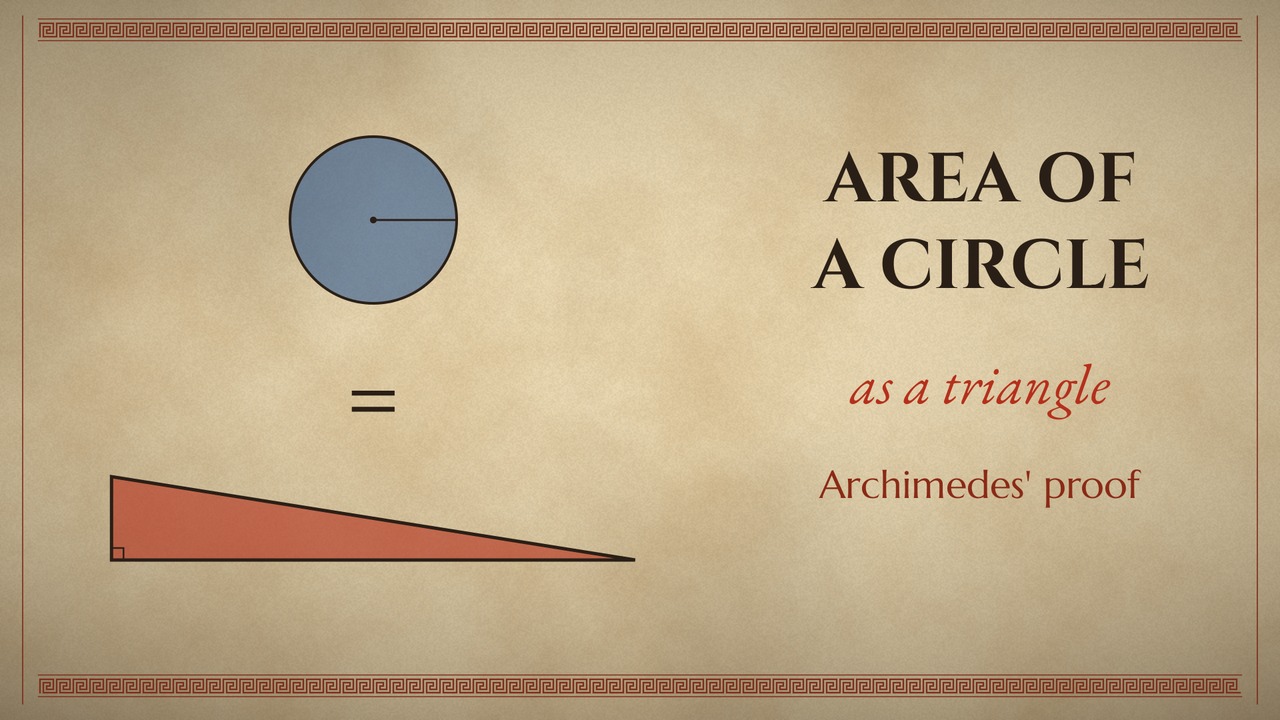
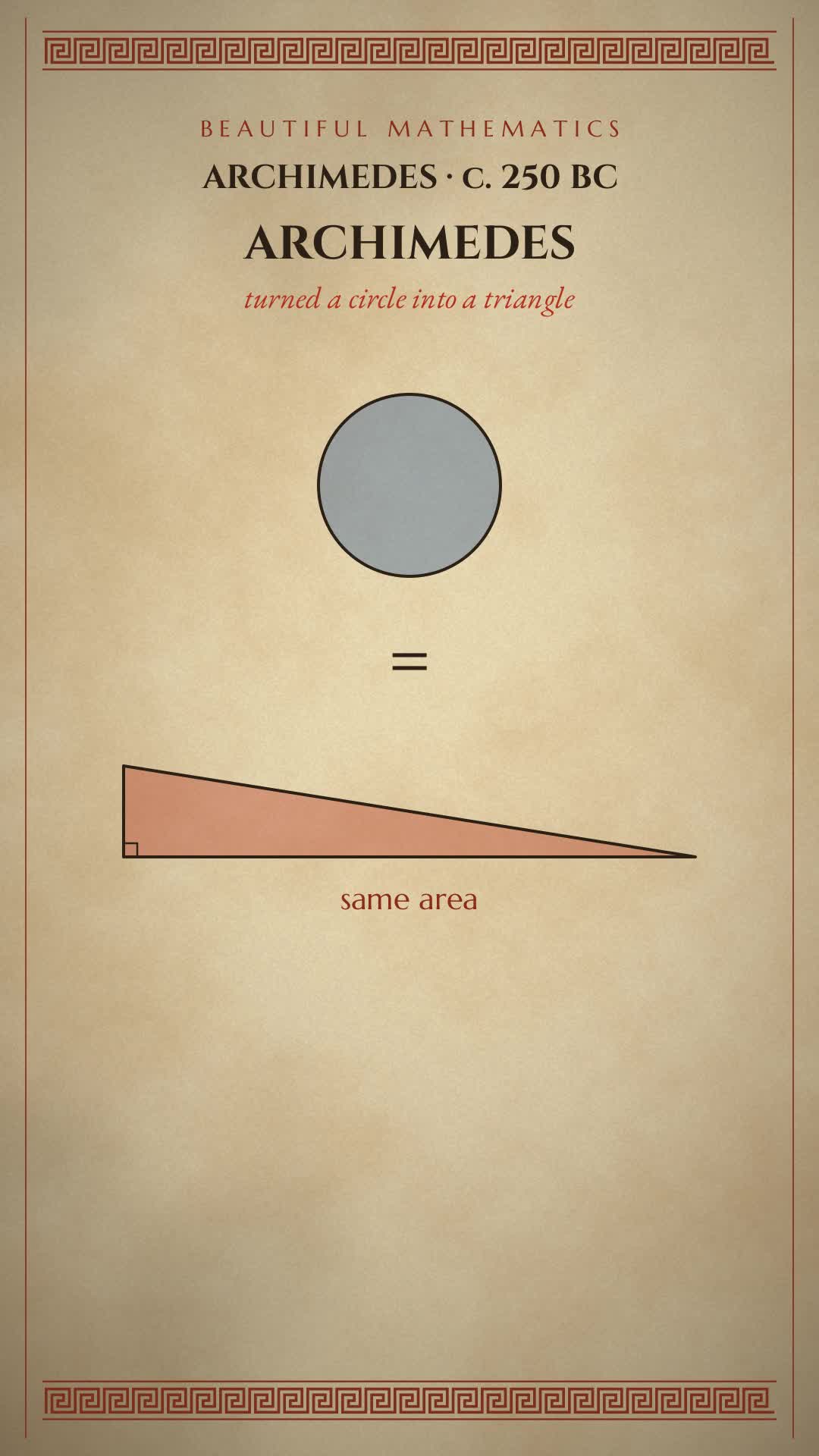
Archimedes proved that a circle has the same area as a right triangle whose two shorter sides are the radius r and the circumference C. That area is ½ · r · C, and since C = 2πr, it equals πr². His proof compares the circle with polygons inside and outside it and shows that the circle can be neither larger nor smaller than the triangle.
A circle as a triangle
Why is the area of a circle πr²? Long before that formula was written, Archimedes gave a geometric answer — a derivation without calculus: a circle has the same area as one particular triangle.
The video loads from YouTube (youtube-nocookie.com) only after you click. See our privacy policy.
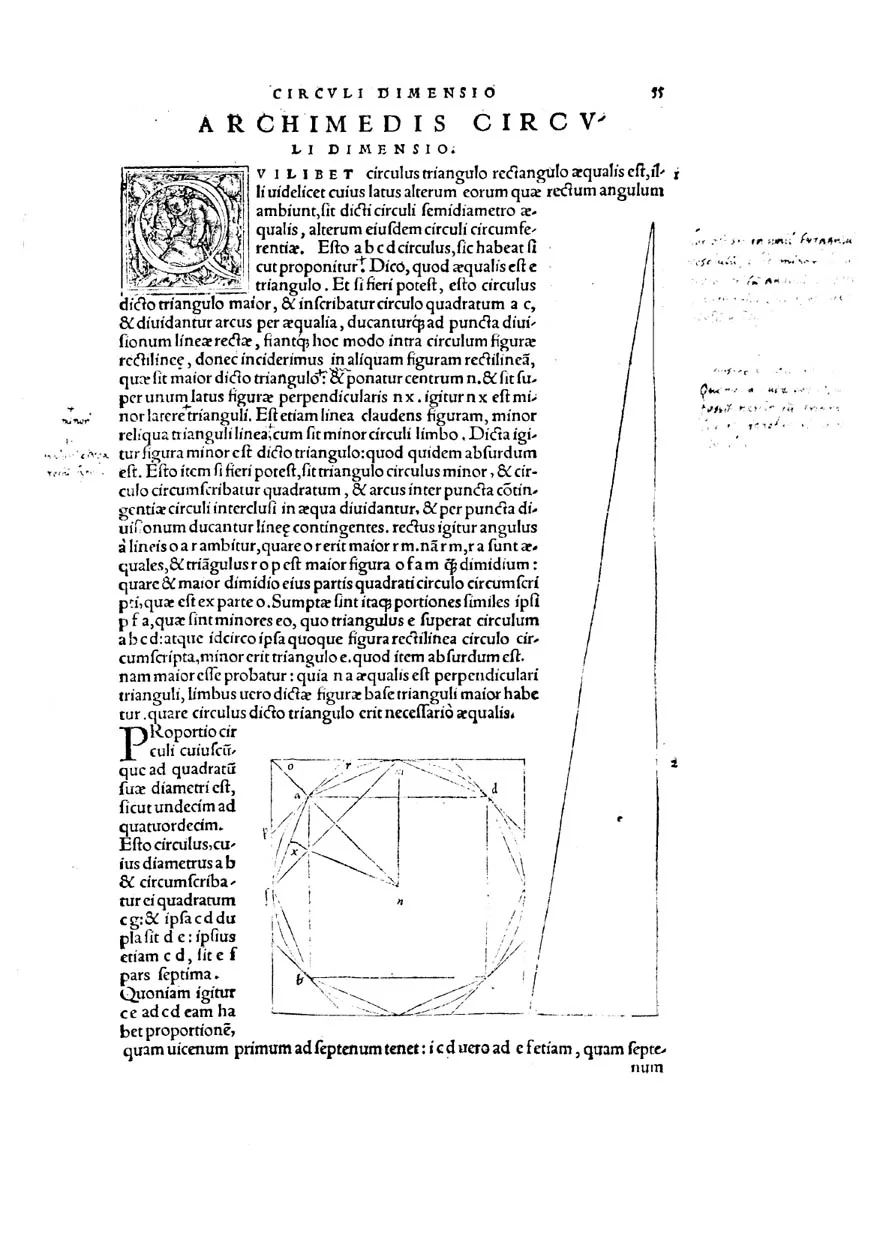
The Measurement of a Circle
Around 250 BC, Archimedes wrote a short work called the Measurement of a Circle. What survives is probably only part of a longer book. Its first proposition is the one we want:
A curved shape and a straight one, with exactly the same area.
A visual argument
Imagine cutting the circle into thinner and thinner rings and straightening each one. The outer ring is as long as the circumference, the inner ones are shorter, down to a point at the centre. Stacked, they form a triangle whose base approaches the circumference and whose height is the radius.
Polygons inside the circle
Archimedes worked with polygons. A regular polygon can be cut into triangles from its centre, so its area is
½ · perimeter · (distance from the centre to a side)
Double the number of sides again and again, and the polygon hugs the circle more and more closely. The gap between the two can be made smaller than any area you choose.
Two impossibilities
Call the triangle K (legs r and C).
- Suppose the circle were larger than K. Then an inscribed polygon can be made larger than K too. But its perimeter is shorter than the circumference, and its distance to the sides is shorter than the radius — so its area is smaller than ½ · r · C = K. Impossible.
- Suppose the circle were smaller than K. Then a polygon drawn around the circle can be made smaller than K. But its distance to the sides is exactly the radius, and its perimeter is longer than the circumference — a result Archimedes establishes at the beginning of On the Sphere and Cylinder. So its area is larger than K. Impossible again.
The circle is neither larger nor smaller than the triangle. It is equal. In today's notation:
½ · r · 2πr = πr²
Archimedes used the same squeeze from inside and outside for a harder shape: the volume of a sphere.
Pi between two fractions
The same short book goes further. With polygons of 96 sides, inside and outside the circle, Archimedes showed that the circumference lies between 3 10⁄71 and 3 1⁄7 times the diameter.
3 10⁄71 ≈ 3.1408 and 3 1⁄7 = 22⁄7 ≈ 3.1429
Three and one seventh is 22⁄7, the value many people still use for π. It is the upper bound Archimedes obtained from the outer polygon — not an exact value of π.
Try it yourself
Using 22⁄7 as an approximation, a circle of radius 7 has a circumference of about 44. What area does Archimedes' triangle give? And for a circle of radius 14?
The video loads from YouTube (youtube-nocookie.com) only after you click. See our privacy policy.
Sources
- Archimedes, Measurement of a Circle, Propositions 1 and 3 — T. L. Heath, The Works of Archimedes (Cambridge, 1897)
- Archimedes, On the Sphere and Cylinder I, Proposition 1 (the perimeter of a circumscribed polygon is greater than the circumference) — Heath (1897)
- E. J. Dijksterhuis, Archimedes (on the surviving text as part of a longer work)
- The rings picture as a visual limit argument; a very similar idea appears in Abraham bar Hiyya (12th century) — MAA Convergence, “The Mathematical Cultures of Medieval Europe”
Image credits
- Measurement of a Circle, Proposition 1 — first printed edition (Basel, 1544), via Wikimedia Commons — public domain
- Figure of the circle and the triangle: drawn by Beautiful Mathematics

Part of: Areas and volumes
Found an error? Write to info@beautifulmathematics.com — corrections are dated on the page.