Volume of a Pyramid: Why One Third? Euclid's Proof with Three Pyramids
Euclid cuts a triangular prism with two plane cuts into three pyramids. They have different shapes, but each pair has equal bases and equal heights, so all three have the same volume. Each is therefore one third of the prism — and any pyramid is one third of the prism with the same base and height: V = ⅓ · base · height.
Why one third?
The volume of a pyramid is ⅓ · base · height. Most of us learn this rule at school. But why one third, and not a half? Euclid's Elements gives an answer you can see — a proof of the formula without calculus: a prism cut into three pyramids that look different, but hold exactly the same amount.
Democritus and Eudoxus
The rule is older than Euclid. Archimedes wrote that Democritus first stated it, without a proof. The first proof, he says, came from Eudoxus, in the 4th century BC.
Euclid's Elements, written around 300 BC, contains a proof of the result in Book XII. Proposition 7 is the decisive step:
Two cuts, three pyramids
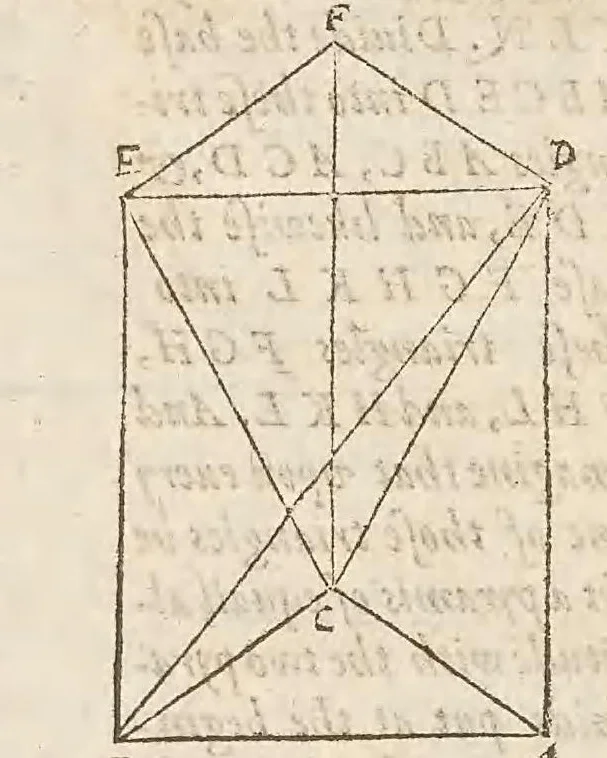
- Start with a prism whose base is a triangle ABC and whose top is a copy of it, DEF (D above A, E above B, F above C).
- Cut through B, C and D. This removes a pyramid with the bottom triangle ABC as its base and D as its tip.
- What is left is a pyramid with a four-sided base. Cut it through C, D and E, and it splits into two pyramids with triangular bases. The prism is now three pyramids.
Equal, but not alike
The three pieces do not have the same shape. So Euclid uses another fact, proved a little earlier in Book XII (Proposition 5): pyramids with equal bases and equal heights have equal volumes.
- The wall ABED is a parallelogram, and the line BD cuts it into two equal triangles, ABD and EBD. Two of the pieces can be viewed as pyramids standing on these triangles, with the same tip, C. So they are equal.
- The wall BCFE is cut by CE into two equal triangles, BCE and CEF. The second and third pieces stand on them with the common tip D. So they are equal too.
All three hold the same volume — each is one third of the prism.
One third of the prism
Euclid adds a corollary:
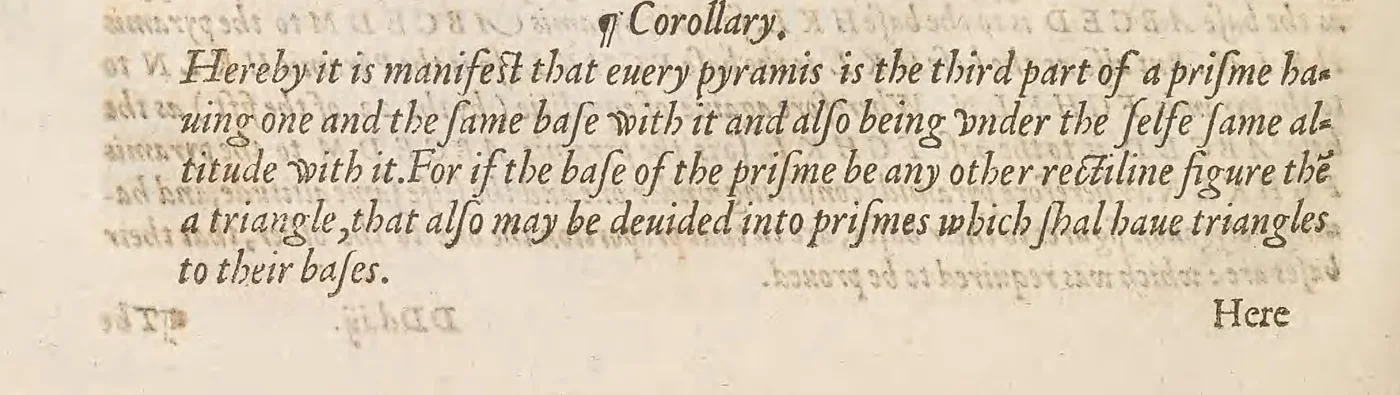
A prism holds base × height, so a pyramid holds
V = ⅓ · base · height
Together with the preceding proposition on pyramids with polygonal bases, the corollary applies to pyramids with any polygon as their base.
And the cone?
The same book of the Elements goes one step further:
So the volume of a cone is ⅓ πr² h — one third again. Archimedes built on this result when he found the volume of a sphere.
Try it yourself
A pyramid has a square base 9 × 9 and a height of 12. What is its volume? And if a prism holds 36 litres, how much does the pyramid with the same base and height hold?
Sources
- Euclid, Elements XII.5, XII.6, XII.7 and its corollary, XII.10 — T. L. Heath's translation, online edition by D. E. Joyce, Clark University
- Archimedes, The Method (preface): Democritus first stated the result, Eudoxus first proved it — MacTutor, “Archimedes on mechanical and geometric methods”
- Archimedes, On the Sphere and Cylinder I, preface
- The Elements of Geometrie of … Euclide of Megara, transl. H. Billingsley (London: John Daye, 1570), fol. 366 (Internet Archive)
Image credits
- Euclid XII.7 — figure and corollary in the first English edition (Billingsley, London 1570), via the Internet Archive — public domain
- Figure of the prism and the three pyramids: drawn by Beautiful Mathematics
Part of: Areas and volumes
Found an error? Write to info@beautifulmathematics.com — corrections are dated on the page.