Euclid's Proof of the Pythagorean Theorem, Step by Step
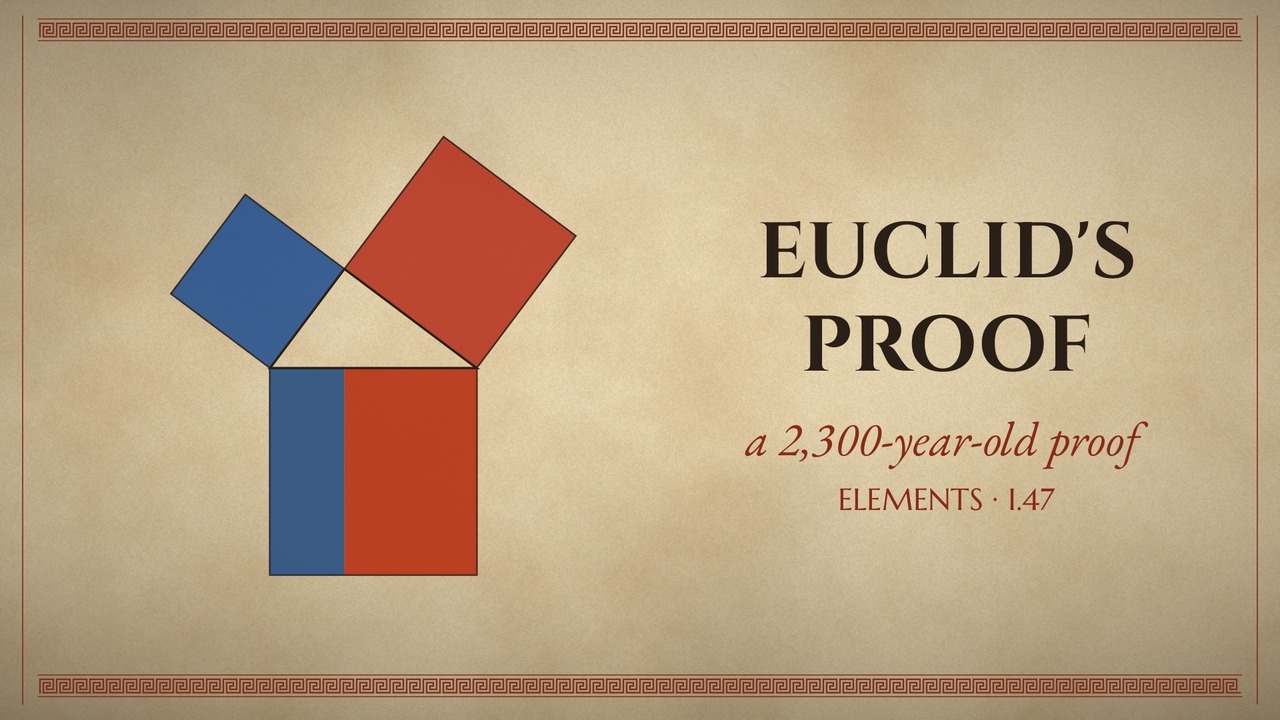
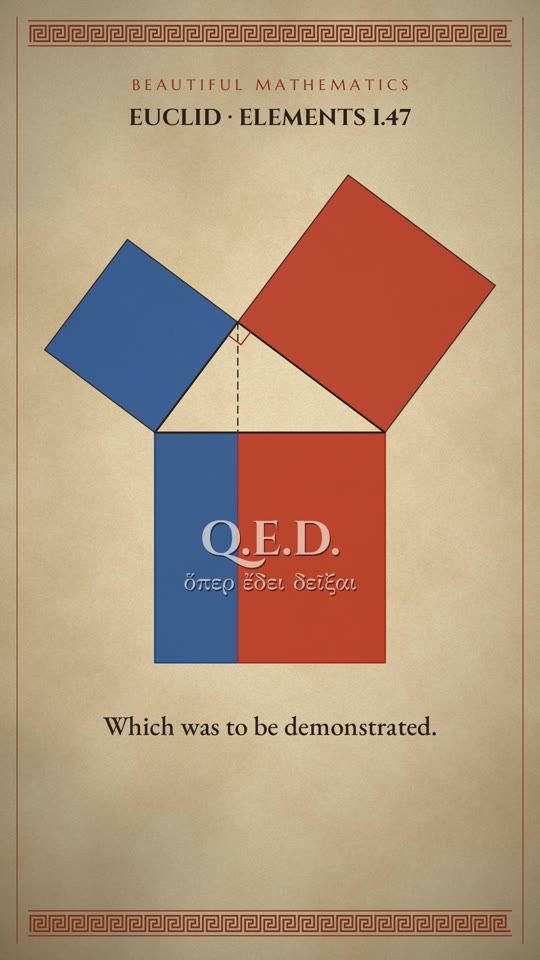
Euclid proves the theorem with areas, not algebra. He draws a square on each side of a right triangle and cuts the big square into two rectangles. Then he shows that each small square has exactly the same area as one of the rectangles — using only congruent triangles and the fact that a triangle is half a parallelogram on the same base.
The theorem in one sentence
In modern words: in a right triangle, the square on the longest side equals the two other squares together — a² + b² = c². Euclid says it without letters for lengths and without any calculation:
For Euclid, a "square" is not a number multiplied by itself. It is a figure — an actual square drawn on a side. So the theorem is a claim about areas: the areas of the two smaller squares add up exactly to the area of the square on the hypotenuse. That is what his proof shows, and it never needs a single number.
The video loads from YouTube (youtube-nocookie.com) only after you click. See our privacy policy.
Who knew it before Euclid?
The relationship is much older than Euclid's proof — and older than Pythagoras.
- Babylon. A clay tablet known as Plimpton 322 (around 1800 BC) lists sets of numbers that fit the rule, whatever its exact purpose was. Another tablet, YBC 7289, shows a square with its diagonal and a remarkably accurate value for the square root of two.
- India. The Baudhāyana Śulbasūtra, a manual for laying out fire altars with stretched cords, states the rule for the diagonal of a rectangle. Its date is uncertain, somewhere between about 800 and 500 BC.
- China. The Nine Chapters on the Mathematical Art, compiled by about the 1st century AD, devotes its ninth chapter, Gougu, to problems on right triangles; in China the rule is still called the gougu theorem.
Pythagoras lived around 570–495 BC but left no writings. Everything we are told about him comes from authors who wrote centuries later.
What Euclid's Elements (Alexandria, around 300 BC) preserves is something different from a known rule: a proof, built step by step from results that were proved before it.
The figure
Euclid starts with a right triangle ABC, the right angle at A. Then:
- On each side he draws a square (using his Proposition 46): ABFG on AB, ACKH on AC and BDEC on the long side BC.
- Through A he draws a line parallel to BD (Proposition 31). It cuts the big square into two rectangles — Euclid calls them BL and CL.
- He joins A to D and F to C.
His claim is precise: the square on AB equals the rectangle BL, and the square on AC equals the rectangle CL. Since the two rectangles make up the big square, the theorem follows.
Euclid's two tools
The core area argument uses two earlier results again and again.
Proposition 4 (congruent triangles). If two triangles have two sides equal and the angle between them equal, they are identical in shape and size — so they also have the same area.
Proposition 41 (half a parallelogram). If a triangle and a parallelogram stand on the same base and between the same parallel lines, the parallelogram is double the triangle. Put differently: slide the tip of a triangle along a line parallel to its base, and its area does not change.
The proof, step by step
- Triangle FBC is half the blue square. Look at triangle FBC and the square ABFG. They share the base FB, and the point C lies on the line through G and A, which is parallel to FB. By Proposition 41, the square is double the triangle.
- Triangle ABD is congruent to triangle FBC. Compare them side by side: FB = AB (sides of the blue square), BC = BD (sides of the big square), and the angle between them is in both cases a right angle plus the angle ABC. They have the same two side lengths and the same included angle, so Proposition 4 makes them congruent.
- Triangle ABD is half the rectangle BL. It shares the base BD with the rectangle, and its tip A lies on the line AL, parallel to BD. Proposition 41 again.
- So the blue square equals the rectangle BL. Both are double the same triangle (steps 1–3).
- The same on the other side. Joining A to E and B to K instead, the same argument shows that the red square equals the rectangle CL.
- Together: square on AB + square on AC = rectangle BL + rectangle CL = square on BC. Which was to be demonstrated.
A step most retellings skip
Step 1 needs C to lie on the same straight line as G and A — otherwise the triangle's tip would not be on the parallel. Euclid does not take this for granted. Since the angles BAC and BAG are both right angles, the two lines AC and AG together make a straight line (his Proposition 14). Only then may he use Proposition 41. This attention to small gaps is exactly what made the Elements the model of a proof for two thousand years.
The converse: Proposition 48
Immediately afterwards, Euclid proves the reverse: if the square on one side of a triangle equals the squares on the other two sides together, the angle between those two sides is a right angle.
The proof on the page
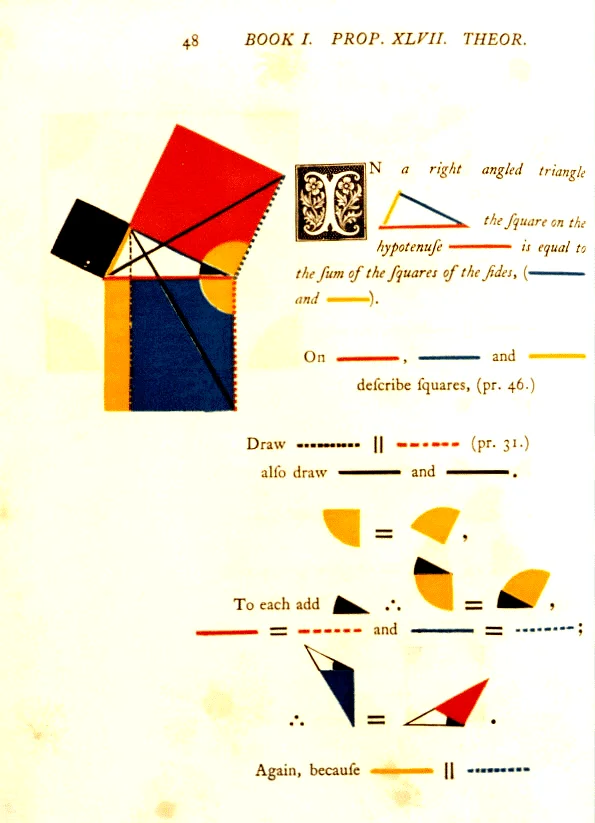
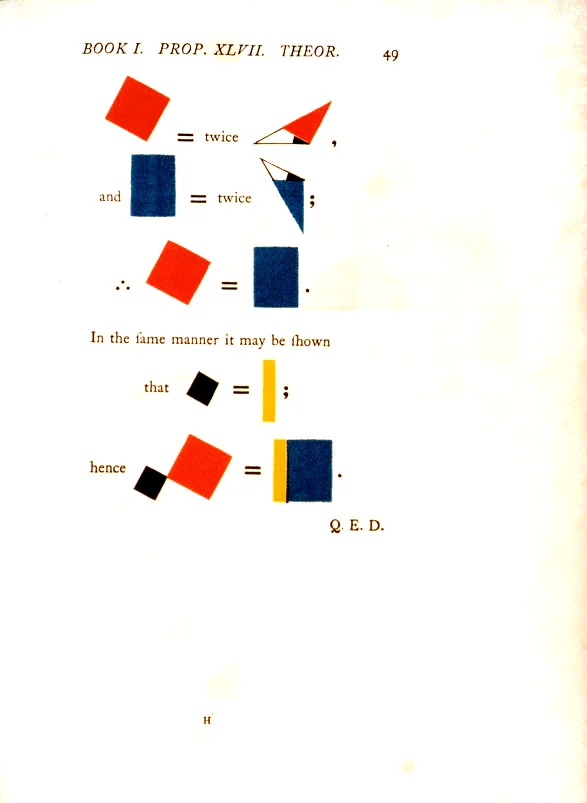
In 1847, the London publisher William Pickering printed Oliver Byrne's edition of the first six books, in which coloured shapes replace most of the letters. Our videos and this site use his red, yellow and blue.
Try it yourself
Take the triangle with sides 3, 4 and 5 (the right angle between 3 and 4).
- The squares on the short sides have areas 9 and 16; the square on the long side has area 25.
- The line through A meets the long side at a distance of 9 ⁄ 5 = 1.8 from B. So the rectangle BL is 1.8 wide and 5 high: area 9 — exactly the square on the side of length 3.
- The other rectangle is 3.2 wide: area 16.
Check it for another right triangle, for example 5, 12, 13. Where does the line through A meet the long side?
The video loads from YouTube (youtube-nocookie.com) only after you click. See our privacy policy.
Why it still matters
The theorem itself works quietly everywhere: the distance between two points on a screen, on a map or in a game is computed with it, and in any number of dimensions, distance is still the square root of a sum of squares. Euclid's proof mattered in a different way — for more than two thousand years, the Elements was one of the principal models for how mathematical proof was taught and understood. The same book later turns from areas to volumes: in Book XII, Euclid shows why a pyramid is one third of its prism.
Sources
- Euclid, Elements, Book I, Propositions 4, 14, 31, 41, 46, 47 and 48 — online edition by D. E. Joyce, Clark University: mathcs.clarku.edu/~djoyce/elements
- T. L. Heath, The Thirteen Books of Euclid's Elements, vol. 1 (Cambridge, 1908), notes on I.47 — including Proclus' remarks on the ox story
- Plimpton 322, clay tablet, c. 1800 BC (Columbia University, Rare Book & Manuscript Library); YBC 7289 (Yale Babylonian Collection)
- Baudhāyana Śulbasūtra, rule for the diagonal of a rectangle (date uncertain, c. 800–500 BC)
- On the Egyptian rope-stretcher story: no surviving ancient Egyptian source describes a 3-4-5 rope; the story spread through 19th-century histories (often traced to Moritz Cantor)
- The Nine Chapters on the Mathematical Art, chapter 9 (Gougu) — MacTutor History of Mathematics, “Nine chapters on the mathematical art”; K. Shen, J. N. Crossley, A. W.-C. Lun, The Nine Chapters on the Mathematical Art: Companion and Commentary (Oxford, 1999)
- Oliver Byrne, The First Six Books of the Elements of Euclid (London: William Pickering, 1847), pp. 48–49
Image credits
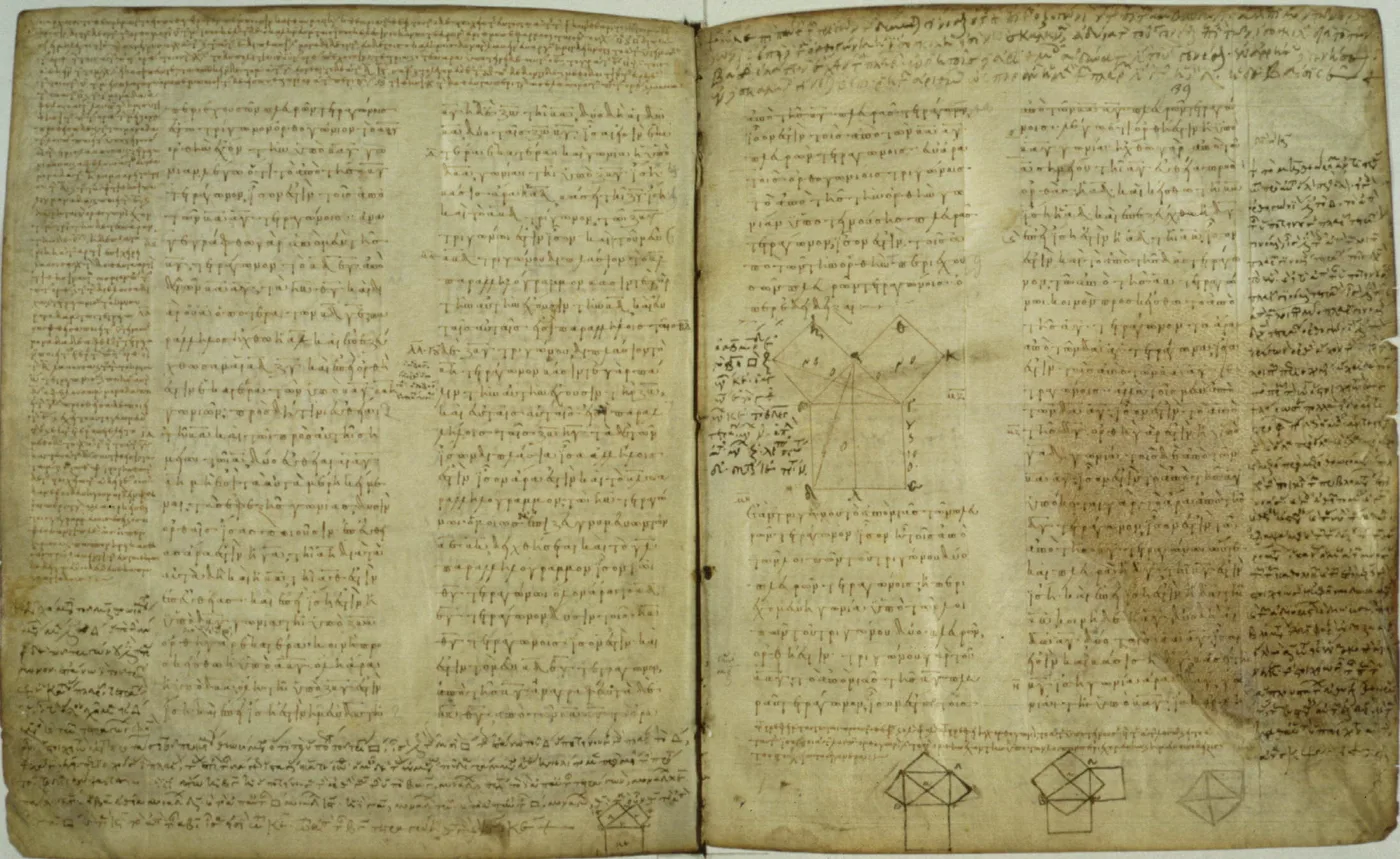
- Manuscript: Euclid I.47 in MS Vat. gr. 190 (Vatican Library), via Wikimedia Commons — public domain
- Byrne's Euclid, pp. 48–49 (1847), via Wikimedia Commons (p. 48, p. 49) — public domain
- Figure of I.47: drawn by Beautiful Mathematics in Byrne's colours


Part of: The Pythagorean theorem
Found an error? Write to info@beautifulmathematics.com — corrections are dated on the page.