Garfield's Proof of the Pythagorean Theorem: the Congressman's Trapezoid
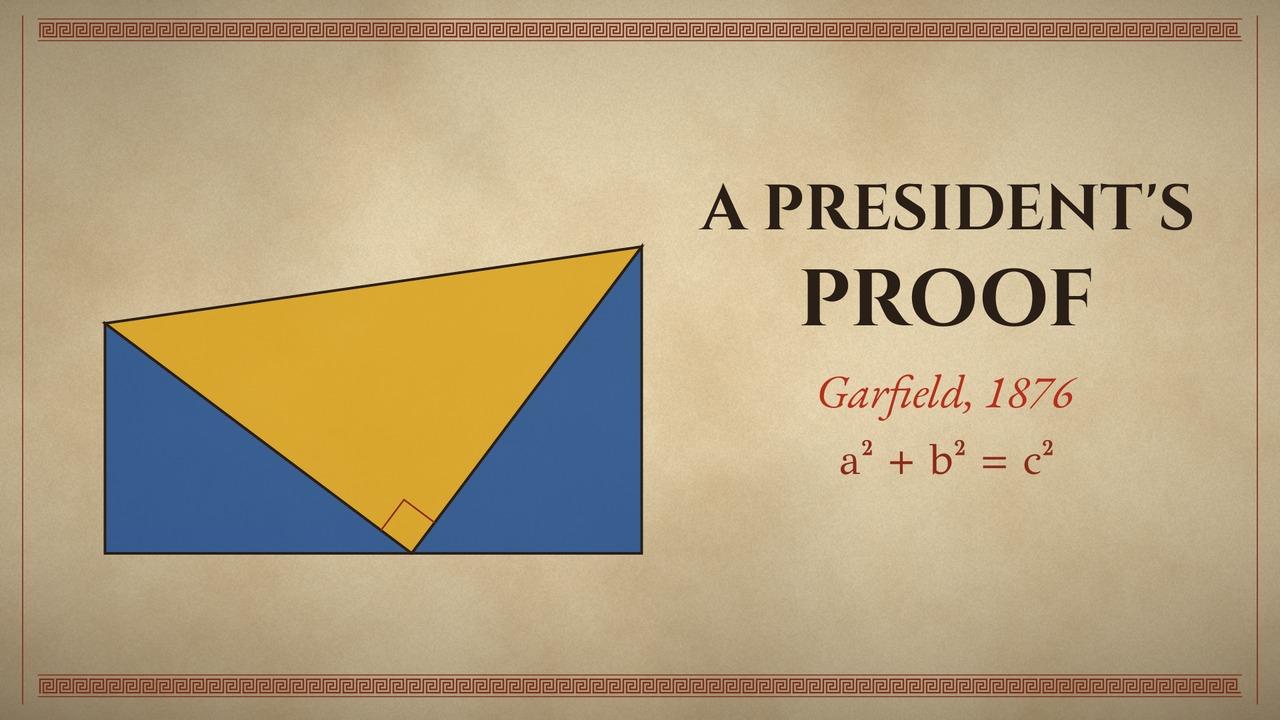
Garfield put two copies of a right triangle (legs a, b, hypotenuse c) side by side so that, together with a third triangle between them, they form a trapezoid. He worked out its area twice — once as a trapezoid, once as three triangles. Setting the two results equal and simplifying gives a² + b² = c².
A proof from Congress
On 1 April 1876, the New-England Journal of Education, a teachers' weekly published in Boston, printed a short proof of the Pythagorean theorem. Its author was not a mathematician. He was a member of the United States House of Representatives — and five years later he became President.
His proof is still taught, because it needs almost nothing: three right triangles and the area of a trapezoid.
The video loads from YouTube (youtube-nocookie.com) only after you click. See our privacy policy.
Who was Garfield?
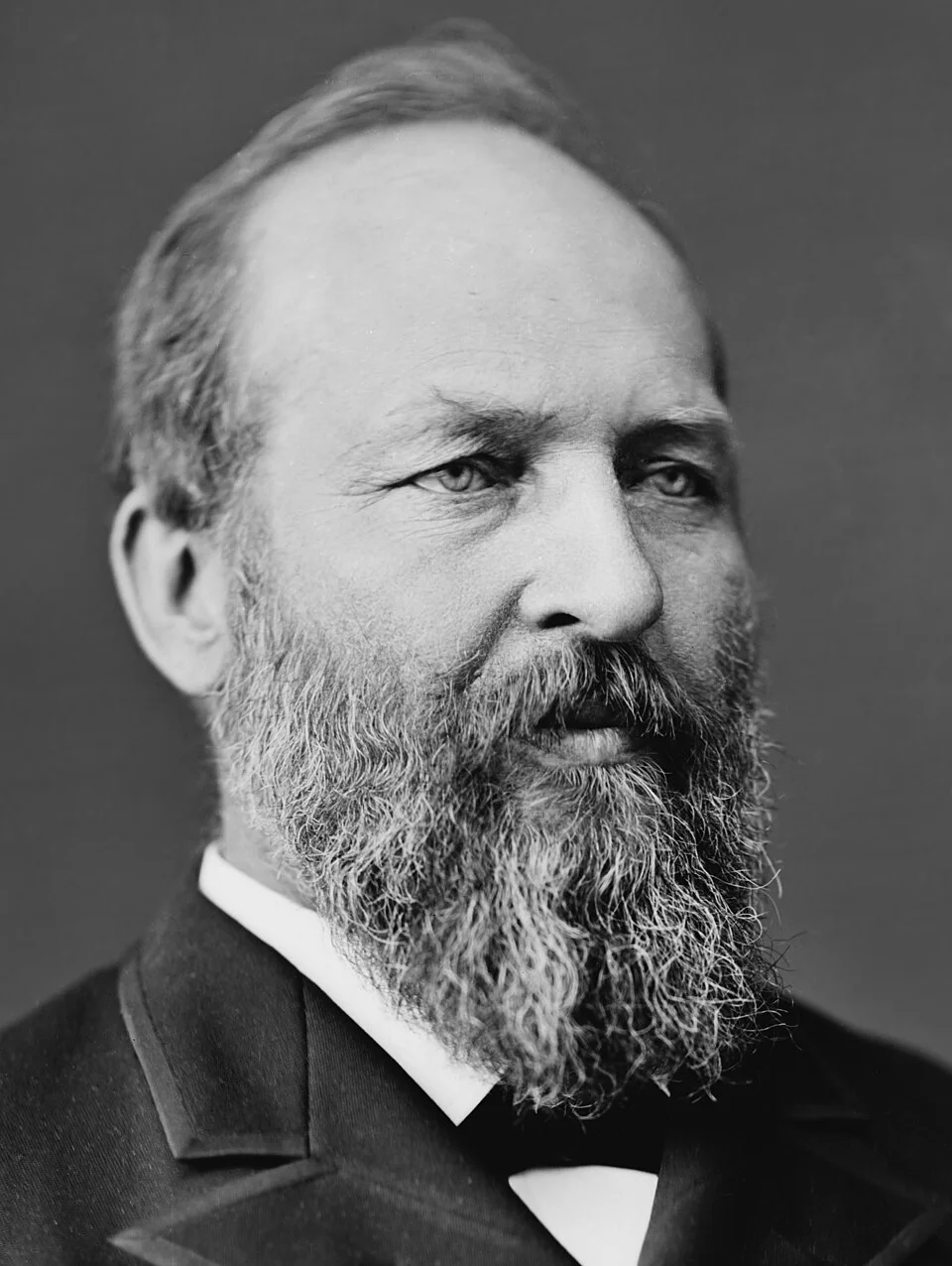
James Abram Garfield was born in Ohio in 1831. Before politics he was a teacher, and later the head of the Western Reserve Eclectic Institute in Hiram, Ohio. He served as a general in the Civil War, and from 1863 he sat in the House of Representatives for seventeen years.
He was elected the 20th President in 1880. In July 1881, only four months into his term, he was shot; he died in September. His proof dates from 1876, when he was still a congressman.
What the journal printed
The note carried the title Pons Asinorum and was signed with the initials J. A. G. The editor introduced it like this:
Pons asinorum — "the bridge of asses" — is traditionally the name of a different result, Euclid's Proposition I.5 about the base angles of an isosceles triangle. Here the name was used for the most famous theorem of all.
Building the trapezoid
- Take a right triangle with legs a and b and hypotenuse c. Lay it on its leg b, so that its leg a stands upright.
- Next to it, lay a second copy on its leg a, so that its leg b stands upright. The two bottom legs now form one straight line of length a + b.
- Join the two upper corners. The outline is a trapezoid: two parallel, upright sides a and b, at a distance a + b from each other.
The middle triangle has two sides of length c — the hypotenuses of the two copies. Why is the angle between them a right angle? Along the straight bottom line, the angles at the meeting point add up to 180°. The two outer ones are the two acute angles of the right triangle, and those add up to 90°. That leaves exactly 90° in the middle.
Counting the area twice
First, as a trapezoid. Area = half the sum of the parallel sides × their distance:
½ · (a + b) · (a + b)
Second, as three triangles. The two blue triangles each have area ab ⁄ 2; the red one has area c² ⁄ 2:
ab⁄2 + ab⁄2 + c²⁄2
Both describe the same shape, so they are equal. Double both sides and multiply out:
a² + 2ab + b² = 2ab + c²
The 2ab cancels on both sides, and what is left is the theorem:
a² + b² = c²
Half of an older picture
Arrange four copies of the right triangle inside a square of side a + b, leaving a smaller tilted square of side c in the middle. Arrangements like this belong to a long tradition of picture proofs of the theorem.
Cut the big square along a diagonal of the tilted square, and each half is exactly Garfield's trapezoid. Geometrically, his proof is one half of this larger picture.
Hundreds of proofs
Garfield's proof is one of hundreds. In 1927, the Ohio teacher Elisha Scott Loomis published a collection of proofs of the theorem; an expanded edition appeared in 1940 and includes Garfield's. Some are by famous mathematicians, some by students — and one by a future President.
For the classical proof with squares on all three sides, see Euclid's proof (Elements I.47).
Try it yourself
Take the triangle with legs 5 and 12 and hypotenuse 13.
- The trapezoid has parallel sides 5 and 12 and width 17: area ½ · 17 · 17 = 144.5.
- The two outer triangles: 30 each. The middle triangle: ½ · 13 · 13 = 84.5.
- Check: 30 + 30 + 84.5 = 144.5.
The video loads from YouTube (youtube-nocookie.com) only after you click. See our privacy policy.
Sources
- J. A. G[arfield], “Pons Asinorum”, New-England Journal of Education 3, no. 14 (1 April 1876), p. 161 (JSTOR 44764657)
- The editor's introduction to the note, quoted in Scientific American, “A Presidential Pythagorean Proof”
- Garfield's diary, entry of 7 March 1876 (showing the proof to a Dartmouth mathematics professor), as summarised in Scientific American
- Biographical dates: Miller Center, University of Virginia, “James A. Garfield”
- Elisha Scott Loomis, The Pythagorean Proposition (1927; 2nd ed. 1940)
Image credits
- Portrait of James A. Garfield, Brady-Handy Photograph Collection (Library of Congress), via Wikimedia Commons — public domain
- Figure of the trapezoid: drawn by Beautiful Mathematics in Byrne's colours

Part of: The Pythagorean theorem
Found an error? Write to info@beautifulmathematics.com — corrections are dated on the page.